

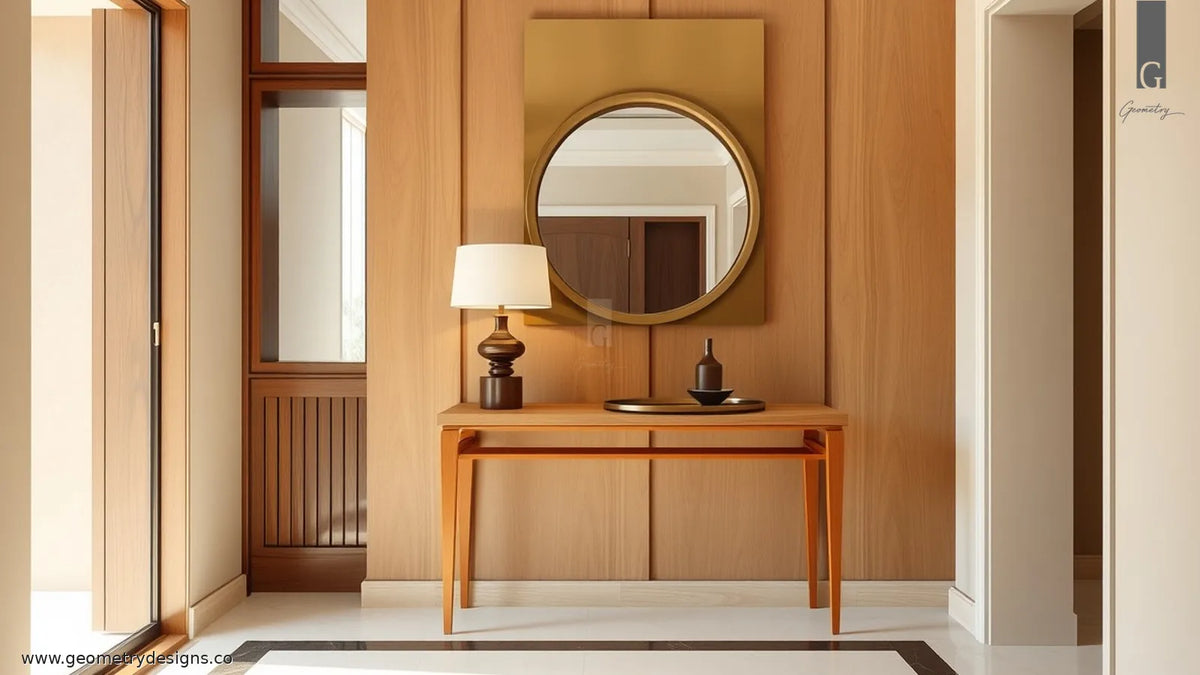
Short answer: Place a statement console in an entryway by protecting circulation first, then committing to one clear landing zone. Leave a continuous walk path of about 90-100 cm where possible, keep the console depth modest relative to the foyer, and style only what supports arrival - keys, a tray, a lamp, and one intentional art or mirror move. Statement console placement in an entryway is a traffic decision before it is a styling decision.
Geometry POV: At Geometry Designs, a console is not filler furniture for the first wall you see. It is a designed pause: a surface that greets guests, holds daily rituals, and frames the room beyond. Design Education here means reading width, depth, sightlines, and door swing - then choosing a handcrafted piece that feels calm under Indian apartment constraints, not crowded by them.
How do I place a statement console in an entryway?
Start with the path, not the wall. Open the main door fully and mark the swing. Walk from the threshold toward the living room or corridor without turning sideways. That clear lane is non-negotiable. The console belongs beside that lane, not across it.
Next, decide the console's job. Is it a drop-zone for keys and mail, a sculptural welcome with a lamp and tray, or a gallery ledge under a mirror? One primary job keeps the surface quiet. When a console tries to be storage, gallery, and coat dump at once, the entryway feels crowded even if square footage is adequate.
Measure the wall run available after subtracting door clearance, switchboards, and any shoe-cabinet overlap. Choose a console length that leaves breathing room on both ends - typically a few centimetres of visible wall so the piece reads intentional rather than jammed. Prefer a depth that keeps shoulders clear when two people pass; shallow, well-proportioned consoles often serve Indian foyers better than deep buffet-like pieces.
What clearance and proportion rules keep an entryway calm?
Think in three layers: walk path, furniture footprint, and visual weight.
- Walk path: Aim for a continuous clear strip so arrivals do not brush the console edge. In tight Indian apartments, protect whatever you can - even a slightly narrower but unbroken path beats a wider path interrupted by stools, baskets, and plant stands.
- Footprint: Align the console parallel to the wall. Avoid floating it into the circulation lane. If the foyer is a short corridor, place the console on the longer side wall rather than opposite the door where it becomes an obstacle.
- Visual weight: A statement console can be bold in craft - carved legs, rich timber, a distinctive silhouette - while remaining quiet in clutter. Heavy material with light styling reads luxurious; heavy material with stacked objects reads cramped.
Check sightlines from the living room. The console should look composed when you glance back toward the entrance. If the first view is a pile of chargers, plastic bags, and mismatched frames, the craft of the piece is wasted.
How should you style a statement console without crowding it?
Limit the surface to a small set of roles: light, landing, and one focal object.
A lamp or wall sconce near the console softens arrival and makes the piece usable after dark. A tray or shallow bowl gathers keys and cards so they do not scatter. A mirror above can expand a narrow foyer - but size it to the console width, not to the entire wall, so the composition feels designed. One vase or sculptural object is usually enough; two competing tall objects crowd the air above the surface.
Store bulk elsewhere. Shoes, umbrellas, and bags need dedicated nearby storage that does not sit on the console. If you need drawers or a lower shelf, keep them visually quiet and reserve the top for the greeting moment.
Seasonal flowers or a single art object can rotate; permanent stacks of mail cannot. Treat the console like a designed product vignette, not a household inbox.
Checklist: statement console placement before you buy or install
| Check | Why it matters | Pass signal |
|---|---|---|
| Door swing clearance | Prevents collisions and scuffed finishes | Door opens fully without hitting the console |
| Walk-path width | Keeps arrivals comfortable for two people when possible | Clear continuous path beside the piece |
| Console depth vs foyer depth | Avoids shoulder bumps in narrow Indian entries | Console sits flush to wall with usable pass space |
| Length vs wall run | Prevents a jammed, wall-to-wall look | Breathing room at ends; switches/panels still accessible |
| Power and lighting | Supports lamp use without extension-cord clutter | Outlet nearby or planned wall light |
| Mirror/art proportion | Controls visual noise above the surface | Art/mirror roughly related to console width |
| Daily drop-zone plan | Stops clutter from owning the statement piece | Tray + nearby storage for shoes/bags |
| Craft finish at edges | Entry pieces take more contact | Finish and corners feel durable under touch |
Where does Geometry Designs fit in an entryway console plan?
Geometry Designs approaches entryway furniture as craft that earns its place in daily life. A statement console should feel considered in timber, joinery, and proportion - then stay uncluttered enough that the craft remains visible. Browse the Geometry Designs collection for pieces that can hold a foyer with quiet presence, and use the Geometry Journal for related room-planning ideas such as what a designer notices first in a luxury living room and catalogue piece or bespoke furniture: how to decide.
If you are planning a custom console depth, length, or finish for a specific foyer, contact Geometry Designs with your wall measurements, door swing notes, and how the entry connects to the next room. Clear measurements beat mood-board guesswork.
FAQ
How much space should I leave in front of a statement console?
Prioritise a continuous walk path beside the console rather than a deep unused strip in front of it. In practice, keep the console against the wall and protect the main circulation lane from threshold to the next room.
Can a statement console work in a very small Indian apartment foyer?
Yes - choose a shallower depth, a clearer silhouette, and stricter styling. Small foyers fail when depth and clutter combine; they succeed when the piece is proportionate and the surface stays light.
Should the console face the door or sit on a side wall?
Side-wall placement usually protects circulation better. Opposite-the-door placement only works when the foyer is deep enough that the console never becomes a landing obstacle.
What should go on a statement console every day?
A tray for keys, optional lamp, and one intentional object or floral. Keep shoes, bags, and mail overflow in dedicated storage nearby so the console remains a greeting surface.
Do I need a mirror above the console?
Not always. A well-sized mirror can brighten and expand a narrow entry, but an oversized or busy gallery wall can crowd the statement piece. Match scale to the console and keep the composition calm.


