

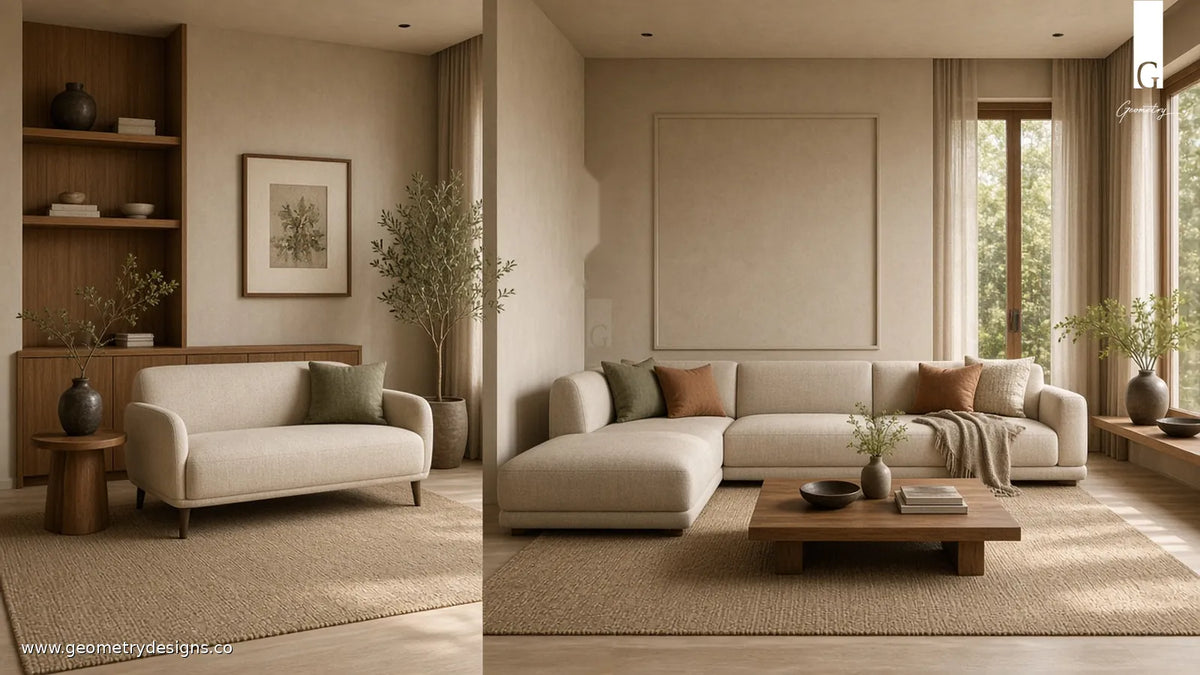
Short answer: Choose a catalogue piece when the size, finish, comfort, and room role already fit. Choose bespoke furniture when the room needs a different proportion, storage logic, material language, or focal point that a standard piece cannot solve. In Indian luxury homes, the better choice is the one that respects circulation, daily habits, and the finish level you actually want to live with.
Geometry POV: At Geometry Designs, we see the same pattern again and again: buyers assume bespoke is always "more luxury," or that catalogue is always the safe shortcut. Neither is true. Catalogue furniture can look considered when the scale is honest. Bespoke earns its keep when a standard SKU fights the room — too short for the wall, wrong depth for the aisle, or too generic to hold the design story. The decision is not prestige. It is fit.
When does a catalogue piece make more sense?
Catalogue works when the dimensions, comfort, finish, and delivery realities already match the room. It is strongest when you need certainty: you can sit in (or clearly visualize) a known form, compare finishes, and move faster without inventing a new brief.
Use catalogue when:
- The wall length, seating depth, and walkway clearances already accept a standard footprint.
- Comfort and posture feel right for how you actually sit — not only how the piece photographs.
- The finish and fabric language already sit well with your floors, rugs, and existing furniture.
- The piece's job is supportive (guest seating, secondary accent, straightforward console) rather than the room's main identity.
In many modern Indian apartments and villas, a well-chosen catalogue lounge piece or accent chair is enough if the room's proportions are generous and the rest of the palette is disciplined. Forcing bespoke on a problem that does not exist only adds process without improving the room.
When should you choose bespoke furniture instead?
Bespoke furniture in India earns its place when a standard piece cannot solve proportion, storage, material story, or focal intent. Ask one blunt question: what fails if this piece stays standard size?
Choose bespoke when:
- Movement fails — a catalogue depth blocks the aisle between sofa and coffee table, or a fixed length leaves an awkward orphan gap on a long wall.
- Storage logic fails — you need a console, bench, or sideboard that hides remotes, prayer essentials, kids' clutter, or work-from-home gear in a way a stock interior does not allow.
- Proportion fails — ceiling height, window rhythm, or rug scale makes a standard sofa or chair look underscaled or oversized.
- Room identity fails — the piece must become the design anchor, carrying a specific wood, cane, metal, or fabric language that catalogue options only approximate.
Bespoke is not automatically better. It is better when it resolves a real constraint. If nothing fails with a catalogue fit, stay with catalogue and spend the attention on rugs, lighting, and styling instead.
How should homeowners and designers decide together?
Homeowners usually feel the daily friction first: the chair that scrapes the curtain, the sofa that crowds Diwali seating, the console that cannot take the tray and the keys. Designers usually see the proportion problem first: the wall that needs a longer line, the corner that needs a resolved L, the finish that must match joinery already specified.
A useful shared method:
- Measure the room role, not only the empty floor — include door swings, AC units, rug edges, and natural walk paths.
- Mark the "honest" catalogue footprint on the floor with tape before ordering.
- Live with that tape for a day. If people keep stepping over it, catalogue depth or length is wrong.
- Decide whether the piece must store, host, or simply look calm. Storage and hosting pressure often tip the brief toward custom furniture.
- Agree the finish ambition early. If the room needs a singular material story, bespoke is often cleaner than forcing three catalogue near-matches.
Catalogue vs bespoke: decision checklist
| Question | Lean catalogue | Lean bespoke |
|---|---|---|
| Does a standard size leave clear circulation? | Yes — aisles feel natural | No — people clip corners or squeeze past |
| Does the wall / window rhythm accept stock length? | Yes — gaps look intentional | No — leftover gaps look unfinished |
| Is comfort already proven for your body habits? | Yes — seat height/depth feel right | No — you need a different posture or depth |
| Does the piece need custom storage or wiring logic? | No — open or simple storage is enough | Yes — specific compartments, charging, or dual use |
| Must this piece carry the room's identity? | No — it supports other anchors | Yes — it is the focal or material story |
| Do speed and certainty matter more than exact fit? | Yes | No — fit outweighs speed |
Score it simply: if three or more answers land in the bespoke column, commission custom. If most land in catalogue, buy well and style with discipline.
Where does Geometry Designs fit in this decision?
Geometry Designs works across both realities of Indian luxury interiors: considered ready pieces when the catalogue fit is honest, and bespoke conversations when proportion, storage, or material language need resolving. Start with the room problem, not the label. Browse the live collection at https://www.geometrydesigns.co/, then bring measurements and photos if you want a custom route via https://www.geometrydesigns.co/pages/contact.
FAQ
Is bespoke furniture always better for Indian luxury homes?
No. Bespoke is better when standard size, storage, or material language fails. A well-chosen catalogue piece can feel more luxurious than a poorly briefed custom one.
When is catalogue furniture the smarter buy?
When dimensions, comfort, finish, and room role already fit, and you value speed and certainty over inventing a new brief.
What is the fastest way to test catalogue vs bespoke before ordering?
Tape the catalogue footprint on the floor for a day. If circulation, seating count, or wall balance still feel wrong, move to a bespoke brief.
Do designers and homeowners need different decision rules?
The checklist is the same. Homeowners weigh daily friction; designers weigh proportion and finish coherence. Both should agree what fails if the piece stays standard.
Should every statement piece be bespoke?
Not necessarily. A statement piece can be catalogue if scale and finish already hold the room. Choose bespoke when the focal role needs an exact proportion or material story a stock piece cannot deliver.
Use this checklist before you decide between ready-made and bespoke — then share your room photos and measurements with Geometry Designs at https://www.geometrydesigns.co/pages/contact if you want a fit-led recommendation.


