

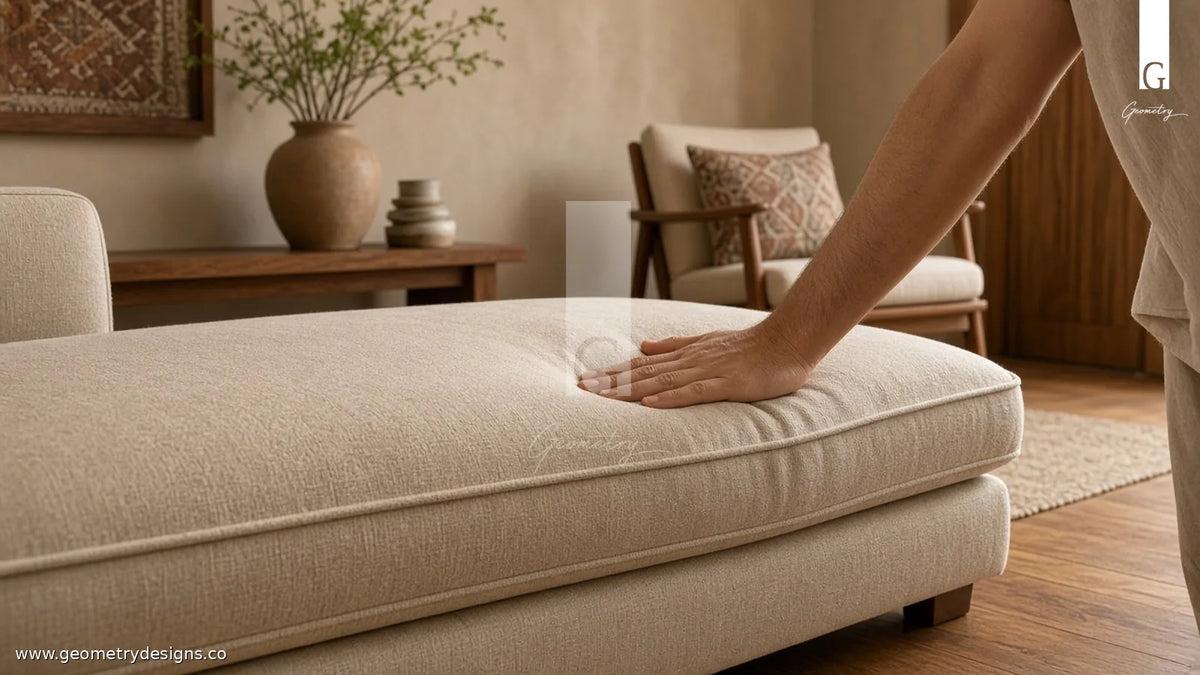
Answer: Test upholstery compression durability by sitting fully for several minutes, standing, and watching how the seat recovers. A good seat softens under load without collapsing to the frame, then returns toward its original height with an even crown—not a lasting crater, a twisted seam, or a hollow that stays soft after you leave.
Firmness tells you how a cushion feels at first touch. Compression durability tells you whether that feel survives real use—evening conversation, monsoon humidity, and the third guest on the same sofa. In Indian homes the mismatch shows up weeks later: a seat that looked plump in the showroom and now cups around every sit. Geometry Designs treats this as a craft check you can run with your body, not a lab ticket you need before you buy.
This Craft And Material Proof guide walks through a practical sit-test: before purchase, after short use, and after longer evenings. Use it alongside how to compare upholstery cushion firmness before buying when you shortlist seating from Geometry sofas, then brief bespoke seating through Contact if recovery fails the checklist.
What Is Upholstery Compression—and Why Is It Not the Same as Firmness?
Firmness is the resistance you feel when you first press the seat. Compression is how much the cushion changes shape under your weight, and how completely it returns when the weight leaves. A medium-firm seat can still fail durability if the core packs down permanently. A softer seat can pass if recovery is honest and even.
Designers often separate the two questions on purpose. The quality cues in how to spot quality in upholstered furniture cover seams, frame language, and fabric honesty. Compression testing adds a time-based proof: sit, leave, watch—catching cores that densify too quickly or fill that migrates forward.
How Can I Test Upholstery Durability Before Buying?
Arrive prepared to sit the way you live—not a polite perch for thirty seconds. Sit fully into the seat you will use most, in your real posture. Stay for at least three to five minutes so heat and pressure can settle the core.
While seated, notice three things: whether you bottom out to a hard frame rail, whether the fabric pulls hard at seams, and whether your hips feel supported or swallowed. Then stand. Watch the crown for one to three minutes. Healthy compression softens under load and rises again with a calm, even surface. Weak compression leaves a lasting hollow, a twisted welt, or a soft pocket that still looks occupied.
What Should I Watch Immediately After Sitting?
Immediate recovery is the first signal. Within a minute, the seat should begin returning toward its original height. A slow return can still be acceptable if the crown stays even; a fast return that leaves a permanent crease or a skewed corner usually is not.
Check the cover next. Aggressive compression shows as wrinkled fabric pools, stretched piping, or a welt that rotates away from the frame line. Those are craft failures, not "breaking in." Use the same calm eye as what a designer notices first in a luxury living room: what leads the eye should still be proportion and finish, not a dent map of the last sit.
How Do I Evaluate Compression After Longer Use?
If you can return after a longer sit—or trial seating at home—repeat the test after twenty to thirty minutes of real use, then again the next day if the piece stays with you. Overnight recovery matters in humid climates: foam and fibre can feel softer in monsoon evenings and need honest rebound by morning.
Mark the same seat position each time and photograph the crown from a fixed angle. Look for progressive packing: a hollow that deepens each evening, fill that slides toward the front rail, or a back that no longer meets the seat cleanly—even if the first sit felt luxurious.
Compression Sit-Test Checklist
| Test | What to watch | Pass / Fail signal |
|---|---|---|
| Full sit (3–5 minutes) | Hip support, seam stress, frame contact | Pass: softens without bottoming out. Fail: hard rail, seam scream, or swallowed posture. |
| Stand and watch (1–3 minutes) | Crown height, evenness, welt alignment | Pass: rises evenly toward original shape. Fail: lasting crater, twisted piping, or soft pocket that stays occupied. |
| Cover and edge scan | Wrinkles, pull lines, corner collapse | Pass: fabric settles calm. Fail: pooled fabric, rotated welt, or collapsed corner. |
| Longer use / next-day check | Progressive packing, fill migration, humidity soften | Pass: overnight rebound stays even. Fail: deeper hollow each evening or fill piled at the front edge. |
| Construction peek (if allowed) | Core type vs felt sit | Pass: story matches recovery. Fail: loose fill matching a crater, or thin core matching bottoming out. |
Which Compression Failures Are Common in Indian Homes?
Humidity and long evening sits are the usual stress pair: a seat that felt supportive in an air-conditioned showroom can soften faster after rain. Guest load is the second pattern—the favourite place on a three-seater takes more cycles than the ends. If only one place fails the checklist, treat it as a durability warning and rotate cushions when the design allows it.
When Should Compression Concerns Push You Toward Bespoke Seating?
Choose a custom brief when stock seating repeatedly fails recovery in the sit you actually use, when you need a firmer or softer core than the floor sample offers, or when seat depth and body size disagree with catalogue proportions. Catalogue still works when a sofa or armchair already passes the checklist in your real sit posture.
The decision frame in catalogue piece or bespoke furniture: how to decide applies cleanly here: if the gap is fit, recovery, or posture—not only fabric colour—bring measured photos, sit-test notes, and the room's humidity pattern to Contact. Geometry Designs can then discuss options in sofas and accent chairs against a bespoke core brief without inventing foam specs you have not verified.
FAQ
How can I test upholstery durability before buying?
Sit fully for several minutes in your real posture, stand, and watch recovery for one to three minutes. Pass if the seat softens without bottoming out and returns evenly; fail if a crater, twisted seam, or lasting soft pocket remains.
Is a soft seat automatically less durable?
No. Softness and durability are different. Soft seats can recover honestly; firm seats can still pack down. Judge recovery and evenness, not only first-touch firmness.
How long should recovery take?
Begin watching within the first minute. Full return may take a few minutes. Worry when a deep hollow remains after you leave, or when the next morning still shows yesterday's sit map.
Do I need laboratory foam ratings to buy well?
Helpful when available, not required for a first filter. A careful sit-test catches most buying mistakes; ask for verified specs when you commission custom cores.
Should I retest after delivery?
Yes. Repeat the same seat position after the first week of evenings. Early progressive packing is easier to address than a year of ignored hollows.
Compression durability is the quiet half of seating quality: not how the cushion greets your hand, but how it behaves after your weight leaves. Run the sit-test before you fall for a fabric, and brief Geometry Designs through Contact when recovery—not only colour—needs a bespoke answer. Explore sofas when a catalogue piece already passes the checklist in your real sit.


