

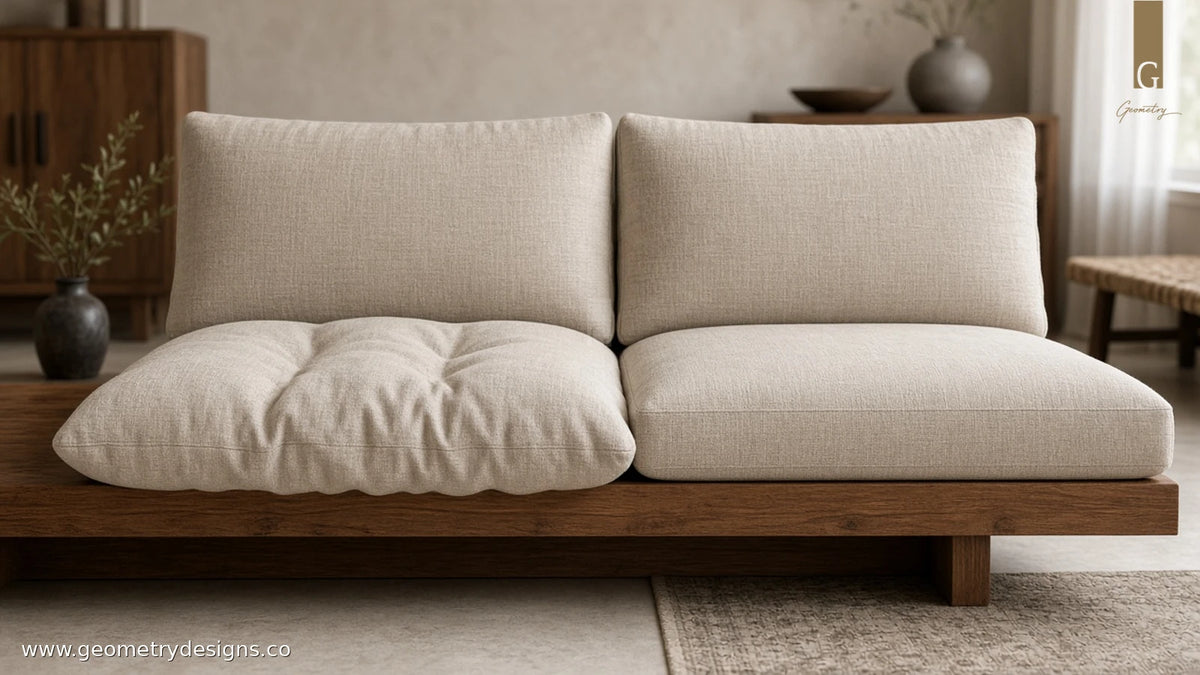
Short answer: Compare upholstery cushion firmness by how quickly the seat recovers after you sit, whether your hips stay supported without a soft “hammock,” and whether the foam or fill still feels even at the front edge after a few minutes. Soft is not automatically luxurious — the right firmness is the one that matches how long you sit and how upright you want to feel.
Geometry POV: In a living room, cushions do more than look plump. They shape whether a statement chair still feels inviting after a long conversation, or whether you keep shifting to find support. Geometry Designs treats firmness as a craft and comfort choice, not a marketing adjective. Handcrafted upholstery should still feel intentional after guests leave — not only in the first showroom sit.
What does “cushion firmness” actually mean when you sit?
Firmness is the relationship between initial give, mid-sit support, and recovery. A soft cushion may welcome you quickly and then keep sinking. A firmer cushion may feel reserved at first and then hold a clearer seated height. Neither is automatically premium. Premium is consistency: the same seat behaviour across the width of the piece, clean seam behaviour under weight, and recovery that still looks composed after use.
When you sit-test, also notice whether the cover skates over the fill or stays calm. Excess surface slip with a soft core can feel plush for the first half-minute and less composed after a longer sit.
Density is not the same as firmness
According to the Polyurethane Foam Association, foam density is mass per unit volume, while firmness is a separate surface-feel measure. Firmness is commonly quantified as Indentation Force Deflection (IFD): the force needed to indent a foam sample by 25% of its original height. PFA notes that firmness is independent of density — you can have high-density foam that feels soft, or lower-density foam that feels firm, depending on the IFD specification. Durability and long-term recovery are evaluated with separate fatigue and recovery tests, not a brief showroom sit. So a short side-by-side sit comparison is a useful check of personal preference; it is not a long-term durability certification, and it does not disclose Geometry Designs’ foam specifications for any piece.
Sources: Polyurethane Foam Association — Foam Performance; Polyurethane Foam Association — Foam Test Methods.
How should homeowners and designers compare firmness in five minutes?
- Sit for a full minute — not a showroom perch. Feel where your weight settles.
- Stand and watch recovery — does the crown return evenly, or does a dent linger?
- Check the front edge — soft collapse at the edge often makes rising from the seat feel awkward.
- Compare two seats side by side — same posture, same shoes off if you live that way at home.
- Ask the manufacturer about the fill stack — foam density or grade, wrap layers, and whether feather or down is used. Treat vague answers as a reason to pause, not as a finished fact.
Soft vs medium vs firm — which fits how you live?
| Feel | Best when | Watch for |
|---|---|---|
| Soft / sink-in | Lounge seating, low conversation, short casual sits | Hammocking hips; slow recovery; messy seams |
| Medium / balanced | Daily living rooms, mixed guests, dining-adjacent lounge | Vague marketing labels without a sit test |
| Firm / structured | Upright conversation, statement chairs, longer hosted evenings | A hard first impression if wrap layers are thin or missing |
Structured comfort — enough give to feel inviting, enough resistance to keep posture steady through a long evening — is one useful aim. The sit test, not the label, decides which side of that balance you want.
Checklist: red flags before you buy
- Only a 10-second sit in the showroom
- “Cloud soft” language with no recovery demonstration
- Uneven crown between left and right seats
- Front edge collapses while the back still feels hard
- Cover wrinkles permanently after one sit
- Fill stack described vaguely — ask for clear foam/wrap/fill details before you confirm
What to ask about climate and care
If your home is humid for part of the year, ask the manufacturer how the cover and fill are expected to behave across seasons, and whether care guidance changes with climate. Use that as a buyer checklist item, then re-check recovery yourself when you sit-test — do not rely on first touch alone.
Geometry seating to explore
Browse Geometry Designs seating collections while you firmness-test: Arm Chairs, Accent Chairs, and Sofas. Bring room measurements and how you actually host, then start a conversation via Contact if you want a fit-led seating brief.
FAQ
Is softer always more luxurious?
No. Luxury is controlled comfort and lasting shape, not maximum sink.
Can firm cushions still feel soft on top?
Yes — a supportive core with a softer wrap can feel welcoming without collapsing.
Does humidity change how cushions feel?
Ask the manufacturer for season-specific guidance, then re-check recovery yourself on a full sit — not only first touch.
Should designers and homeowners test the same way?
Yes on the sit/recovery method; designers should also map firmness to circulation, conversation posture, and how long guests typically stay.
Sit-test two firmness options with the same posture, note recovery, then enquire with Geometry Designs if your room needs a structured comfort brief rather than a soft label.


