

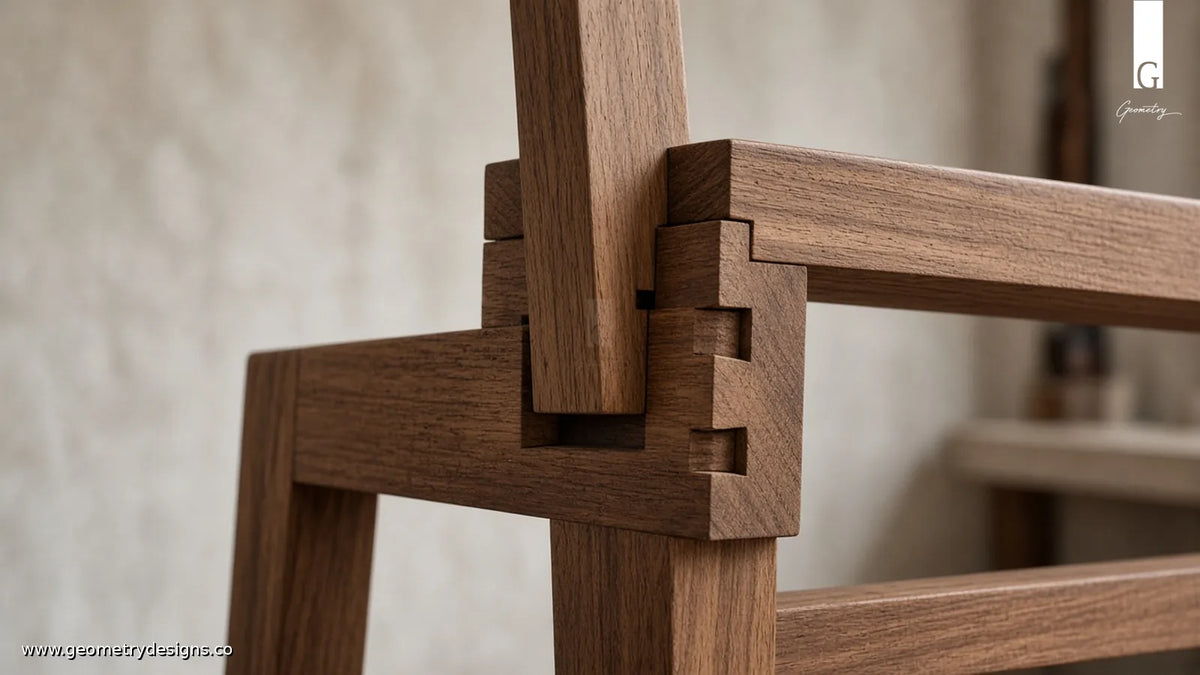
Short answer: Buyers spot premium hand-carved wood joinery by looking past polish to fit, alignment, and how the joint behaves under a fingertip. Tight shoulders, continuous grain where intended, and joinery that looks deliberate — not glued as an afterthought — are the clearest signals. In handcrafted wood joinery signs for Indian luxury homes, the premium feel comes from craft that still reads honest at arm’s length, not only in a wide photograph.
Geometry POV: At Geometry Designs, wood is never only a surface. Joinery is where a piece either earns trust or quietly fails it. Modern Indian luxury rooms put furniture under real light, real hands, and real daily use — so a joint that only looks refined from across the room will not feel premium for long. Craft And Material Proof starts here: how the wood meets wood, and whether that meeting was designed with intention.
What should you look at first on handcrafted wood joinery?
Start with the meeting line. Premium joinery shows a clean, continuous shoulder where faces meet — without thick filler ridges, uneven glue squeeze-out, or a gap that widens when you change viewing angle. Run a fingertip across the joint when you can: it should feel resolved, not patched.
Next, check alignment. Rails, stiles, and panel edges should share a coherent plane. Slight craft variation can exist in hand work; random step-offs, twisted miters, or joints that open on one side usually mean haste or a template that was never refined. Luxury is not “perfect factory sameness.” It is controlled precision that still feels human.
Finally, notice how the joint is expressed. Some premium pieces celebrate a visible mortise-and-tenon, dovetail, or through-tenon as part of the design language. Others hide joinery behind a refined edge. Either approach can be premium — what fails is joinery that looks accidental, over-sanded into mush, or covered because it could not stand inspection.
How can buyers spot premium hand-carved wood joinery?
Use a short buyer sequence that works for homeowners and designers alike:
- Light test — View the joint in daylight and under warm evening light. Premium joinery keeps its integrity; cheap finishing often reveals telegraphing glue lines or uneven sheen only after the room’s light changes.
- Edge honesty — Look at arrises (the soft edge where faces meet). Hand-refined edges feel intentional. Over-rounded “softness” that blurs the joint can hide misfit.
- Grain logic — Where grain is meant to continue or mirror, does it? Where contrast is intentional, is it crisp? Random grain fights at a joint often signal rushed cutting.
- Structural story — Ask what holds the piece together. A credible maker can name the primary joint type and why it suits the load (chair rail, table apron, cabinet frame). Vague answers are a yellow flag.
- Finish vs structure — A thick, glassy coat can make average joinery photograph well. Premium pieces let the joint remain readable after finishing, not buried under product.
For handcrafted wood joinery signs on carved work specifically: carving should meet frames cleanly, without crushed fibres at the joint, and high points should not feel like they were sanded after assembly until the design went soft. Carving and joinery are partners — if one looks compromised to save the other, the piece rarely feels truly premium.
Why does joinery quality matter in Indian luxury homes?
Indian homes ask more of furniture than a showroom snapshot. Strong seasonal humidity swings, air-conditioning cycles, festival hosting, and frequent touch all stress wood movement and joint integrity. A joint that was only glued for appearance will telegraph sooner in these conditions than one cut and fitted for movement and load.
In living rooms, dining rooms, and entry consoles — the pieces guests lean on and children orbit — joinery is also a quiet status signal. Discerning buyers (and designers specifying for them) read craftsmanship the way they read stone veining or fabric hand-feel: up close, under real use. Geometry Designs treats that close-range honesty as non-negotiable for pieces meant to hold a modern Indian luxury interior.
Checklist: how to spot premium wood joinery before you buy
| Check | Premium signal | Walk-away signal |
|---|---|---|
| Shoulder fit | Clean meeting line; fingertip finds little to catch | Visible gaps, filler ridges, or uneven glue lines |
| Alignment | Faces and edges share a coherent plane | Stepped or twisted joints that shift with angle |
| Grain and carving | Intentional grain logic; carving meets frame cleanly | Crushed fibres, mushy edges, or random grain fights |
| Structural clarity | Maker can name joint type and load logic | Only “solid wood” talk with no joinery detail |
| Finish honesty | Joint still readable after finishing | Thick coat that hides misfit or blurry edges |
| Movement readiness | Design accounts for wood movement (panels, frames) | Rigid glue-only panels that fight seasonal change |
Score simply: if two or more walk-away signals appear on a hero piece, pause. Ask for a closer photo of the joint, a maker note on construction, or a showroom inspection under daylight. Premium pricing without premium joinery is decoration, not craft.
Where does Geometry Designs stand on craft and joinery?
Geometry Designs builds trust through Craft And Material Proof — the details you notice when you lean in. Browse the design language and considered pieces at https://www.geometrydesigns.co/. When you are evaluating a wood piece for an Indian luxury home and want a joinery-led read of fit, proportion, and finish honesty, share photos and room context through https://www.geometrydesigns.co/pages/contact.
FAQ
How can buyers spot premium hand-carved wood joinery?
Check shoulder fit, alignment, grain logic, carving-to-frame transitions, and whether the finish still lets the joint read clearly — then ask what structural joint carries the load.
Is visible joinery always better than hidden joinery?
No. Visible dovetails or through-tenons can be beautiful when intentional. Hidden joinery can be equally premium if the fit, strength, and finish are honest. Accidental or covered-up joints are the problem.
Can a glossy finish make average joinery look expensive?
Yes, especially in wide photos. Daylight, a fingertip along the shoulder, and a side-angle view usually reveal whether polish is doing the work of craft.
Do homeowners need technical woodworking knowledge to judge joinery?
Not deeply. A practical checklist — gap, alignment, edge honesty, maker clarity — already separates most premium work from decorative approximations.
Why does joinery matter more in India than in a climate-stable showroom?
Humidity and temperature cycles move wood. Joints designed only for static display rooms often show stress sooner in real Indian homes with AC, monsoon air, and daily use.
Before your next wood furniture decision, run this joinery checklist on the piece you love most — then bring clear joint photos and room notes to Geometry Designs at https://www.geometrydesigns.co/pages/contact if you want a craft-led second opinion.


