

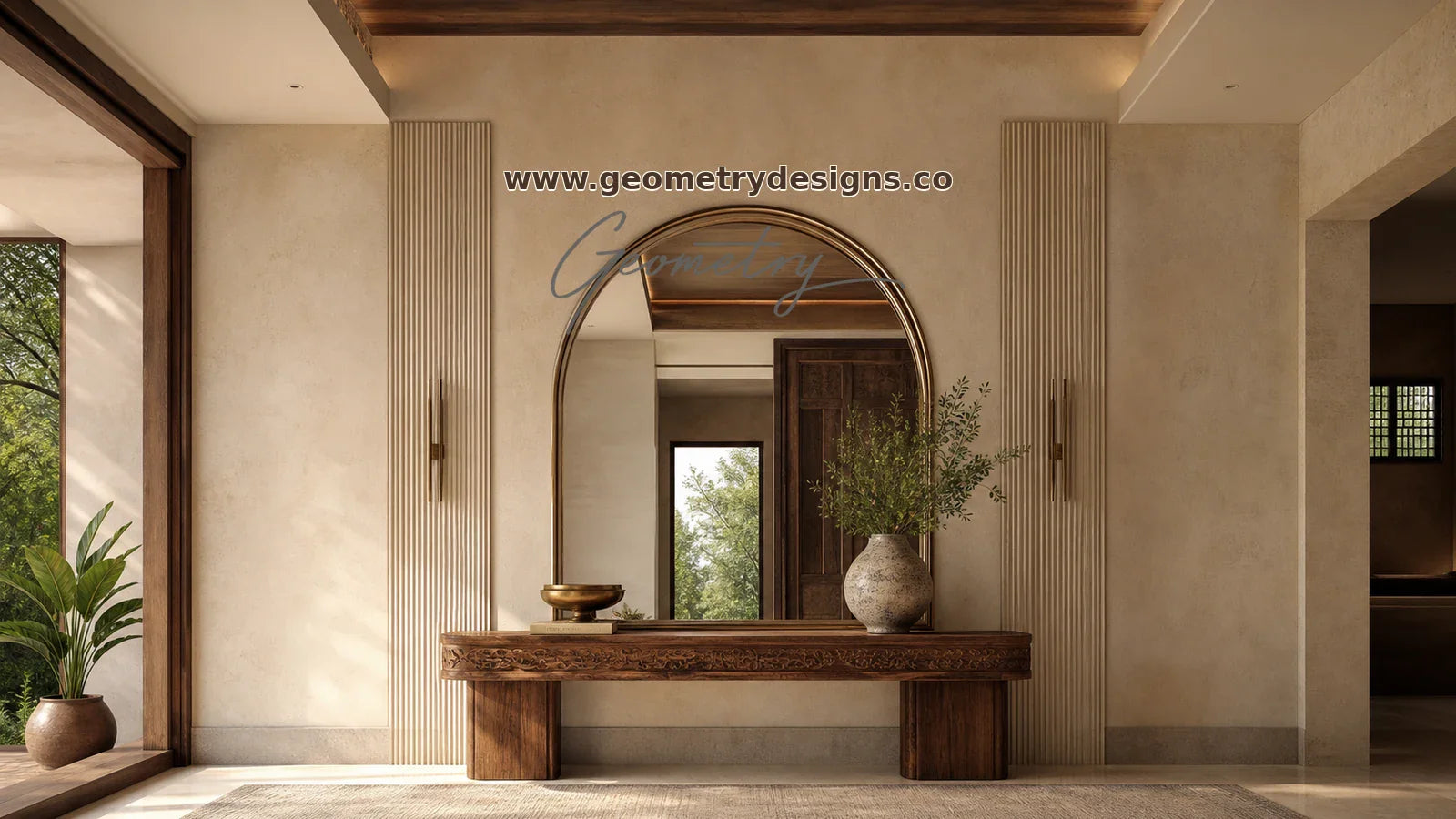
Short answer: A mirror feels architectural when it changes the structure, light, and rhythm of a room, not only the wall decoration. Look for scale, placement, frame depth, reflection quality, and how the mirror relates to doors, consoles, art, lighting, and movement.
In a modern Indian luxury home, a mirror can do more than make a corner look pretty. Geometry Designs treats a strong mirror like a quiet architectural move: it can open a narrow entryway, repeat an arch, bring daylight deeper into the room, or make a console wall feel intentionally designed.
What makes a mirror architectural?
An architectural mirror has presence before it has sparkle. It relates to the room's bones: wall height, ceiling lines, thresholds, niches, columns, doors, and the furniture below it. If the mirror would still make sense in a simple, undecorated room, it is probably doing architectural work.
A decorative mirror usually adds a finish. An architectural mirror changes how the room is read.
How should you judge scale?
Scale is the first test. A small mirror floating above a large console can feel nervous; an oversized mirror in a narrow passage can feel theatrical in the wrong way. The right mirror should feel connected to the wall plane and to the furniture beneath it.
For entryways and living rooms, step back and ask: does the mirror organize the wall, or does it look like an afterthought? If it organizes the wall, it is doing the job.
What should the mirror reflect?
A mirror doubles whatever it sees. Before choosing one, check the reflected view from the main doorway, sofa, dining chair, and walking path. The best reflection is usually light, greenery, a beautiful material, art, or a calmer part of the room.
Avoid placing a statement mirror where it mainly reflects clutter, ceiling glare, open storage, or a busy passage. Luxury is not just what you add; it is what you refuse to multiply.
Architectural mirror checklist
- Wall relationship: Does it align with a niche, panel, doorway, console, or ceiling line?
- Frame depth: Does the frame feel like part of the architecture rather than pasted-on trim?
- Reflection: Does it reflect light, space, or a considered design moment?
- Furniture support: Does the console, bench, or table below it hold the scale?
- Daily life: Can people move around it without worrying about impact or awkward glare?
How can Indian craft stay refined here?
Indian craft works beautifully on mirrors when it is edited. A carved frame, inlay mood, warm wood, brass edge, or hand-finished texture can add soul, but the silhouette should stay disciplined. The aim is not to make the mirror louder; it is to make the room feel more intentional.
If the mirror wall also carries a console, keep the surface styling restrained. One vessel, one lamp, or one sculptural object may be enough.
Where should you use an architectural mirror?
Use it where the room needs structure: an entryway wall, a living-room console wall, a dining-room focal point, or a transitional passage that needs light and depth. It is especially useful in Indian homes where the same wall may need to welcome guests, hold decor, and make a compact space feel more generous.
Explore console tables when the mirror needs a strong furniture partner, or browse Shop all Geometry pieces for pieces that can support an entryway or living-room wall. For room-specific guidance, see Geometry projects or contact Geometry Designs.
FAQ
Should a statement mirror be large?
Not always. It should be large enough to relate to the wall and furniture around it. A smaller mirror can still feel architectural if it aligns with a niche, panel, console, or doorway.
Can a decorative mirror become architectural?
Yes, if the placement, scale, and reflection are planned carefully. The same mirror can feel decorative in one room and architectural in another.
What frame finish feels most premium?
Choose a finish that supports the room's material story: warm wood, aged brass, stone-like texture, or a restrained handcrafted detail. Avoid choosing finish only because it is shiny.
Where should a mirror not go?
Avoid locations where it reflects clutter, harsh light, awkward ceiling fixtures, or a busy corridor. A mirror should simplify and deepen the room, not double the noise.
CTA: contact Geometry Designs if you want help choosing a mirror wall, console pairing, or room proportion for a modern Indian luxury home.


