

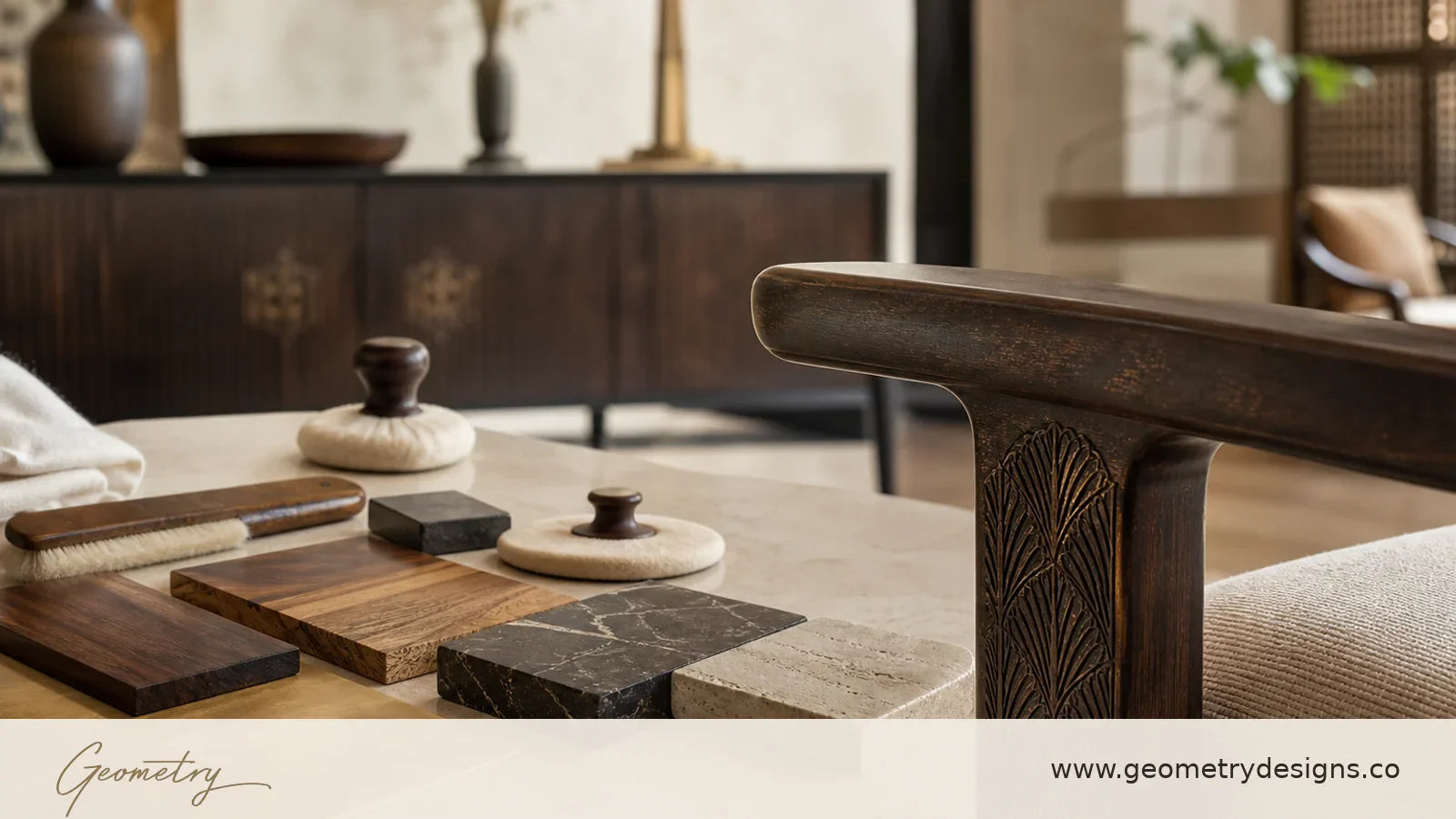
Short answer: A truly handmade finish usually shows controlled variation, layered depth, softened transitions, and small signs of human judgement. It should not look messy; it should look considered. Before buying, inspect how the finish behaves on edges, curves, joints, recesses, and samples, then ask which steps were finished by hand.
In Indian luxury furniture, finish is often where a piece stops feeling factory-flat and starts feeling personal. The difference is not only shine or colour. It is how the surface holds light, how details are softened, and whether the final look feels intentional from close up and across the room.
What does a handmade furniture finish mean?
A handmade finish means that at least part of the surface preparation, colour layering, polishing, distressing, patina, sealing, or final touch-up is guided by hand rather than produced only by a uniform automated process. That does not automatically make every handmade finish better. It simply means the quality depends on craft control, not just machine consistency.
For Geometry Designs, the useful question is not “Is it handmade?” in a vague romantic way. The useful question is: “What human judgement improved the piece?” Did the finish bring out depth? Did it respect the form? Did it make the surface feel richer without hiding the design?
Where should you look first?
Start with the parts that are hardest to fake convincingly: edges, corners, carved details, joints, curves, inner frames, and transitions between materials. A purely flat surface can be easy to make look impressive in a photograph. The quality of a finish is easier to judge where the hand had to respond to shape.
Look for these signs:
- Edges that are softened, not harsh or chipped.
- Colour that has depth instead of one flat coat.
- Recesses where polish, stain, or patina settles naturally.
- Curves that catch light without looking patchy.
- Joints that are cleanly finished rather than ignored.
- Touch points that feel smooth and usable.
If the visible face looks premium but the corners, underside, or inner surfaces look rushed, the finish may be more cosmetic than truly considered.
How can you tell the difference between variation and defects?
Handmade does not mean careless. Natural variation should feel intentional, balanced, and appropriate to the material and design. Defects feel distracting, uneven, rough, sticky, sharp, cloudy, or poorly sealed.
Use this simple filter:
| What you see | Usually acceptable when | Red flag when |
|---|---|---|
| Slight tone variation | It follows the grain, curve, carving, or hand-finished effect | It looks blotchy, accidental, or poorly mixed |
| Visible texture | It adds depth and suits the design | It feels rough where the hand will touch it often |
| Patina or aged effect | It is controlled and repeated with taste | It looks randomly dirty or damaged |
| Polish variation | It helps the form catch light | It creates dull patches, clouding, or sticky areas |
| Edge softness | It improves comfort and proportion | It hides chips, cracks, or poor joinery |
A good handmade finish has character with discipline. It should not ask the buyer to excuse bad workmanship in the name of craft.
What questions should you ask before ordering?
Before confirming a luxury furniture order, ask practical questions that make the finish more than a mood-board word:
- Which finish sample or reference image is approved?
- Which part of the finish is done by hand?
- Will the final piece match the sample exactly, or will there be controlled variation?
- How should the finish be cleaned and maintained?
- Is the finish suitable for the room’s use: entryway, living room, dining area, bedroom, or daily-touch surface?
- Are edges, backs, undersides, and visible inner areas included in the same finish standard?
These questions are especially useful for bespoke furniture in India because homes vary in light, humidity, usage, and styling. The goal is not to make the maker nervous. The goal is to make the brief clear before work begins.
What should a buyer check in photos or video?
If you are reviewing a piece remotely, do not rely only on one polished hero photograph. Ask for close-ups in natural light and a short video that moves across the surface. A moving camera reveals sheen, texture, unevenness, and depth better than a static image.
Ask to see:
- A straight-on hero view.
- A close-up of the finish surface.
- An edge or corner detail.
- A joint or carved/detail area if relevant.
- The finish sample beside the piece if available.
- A video sweep in natural light.
A premium finish should still look composed when the camera gets close. If it only works from far away, it may not be the right finish for a high-touch luxury piece.
Geometry POV: finish should support the room, not shout over it
The best handcrafted finish is not always the loudest. In a modern Indian home, the finish has to work with upholstery, rugs, lighting, stone, wood tones, art, and daily life. A console in an entryway may need a finish that holds up to touch and keys. A statement chair may need arm details that feel smooth, not only dramatic. A dining or living room piece may need a finish that looks beautiful in evening light, not only in a studio photo.
This is why Geometry Designs treats finish as part of design judgement. The finish should make the piece feel more resolved, more personal, and more at home — not merely more decorative.
Quick handmade-finish checklist
Before signing off, check:
- The approved finish sample or visual reference is recorded.
- The surface has depth, not only a flat colour coat.
- Edges, curves, recesses, and joints are finished cleanly.
- Variation looks controlled, not accidental.
- The touch areas feel smooth and usable.
- The finish suits the room’s use and maintenance needs.
- Close-up photos or video support what the hero image suggests.
- Any expected variation is discussed before the order is confirmed.
If you are unsure, compare the finish under two lights: natural daylight and warm indoor light. Luxury furniture lives in both.
FAQ
Is a handmade finish always better than a machine finish?
No. A handmade finish is better only when the craft adds depth, softness, control, or character that suits the piece. A poor handmade finish can still be uneven or fragile. Judge the final quality, not only the label.
What is the easiest way to spot a rushed finish?
Check the corners, edges, underside visibility, inner surfaces, and detail areas. Rushed finishing often shows up where the eye is not expected to look first. A premium piece should feel considered beyond the front-facing photograph.
Should handmade finishes match perfectly across pieces?
They should match the approved direction, but small controlled variation can be normal when handwork is involved. The important part is alignment: the maker and buyer should agree on what variation is acceptable before production or final approval.
What should I ask for before approving a custom finish?
Ask for a finish sample or reference, close-up photos, natural-light video, care guidance, and a written note on what may vary by hand. This protects both the buyer’s expectation and the maker’s process.
CTA
Explore Geometry Designs pieces and finish-led furniture ideas in the Shop All collection, or contact Geometry before confirming a bespoke furniture brief.


