

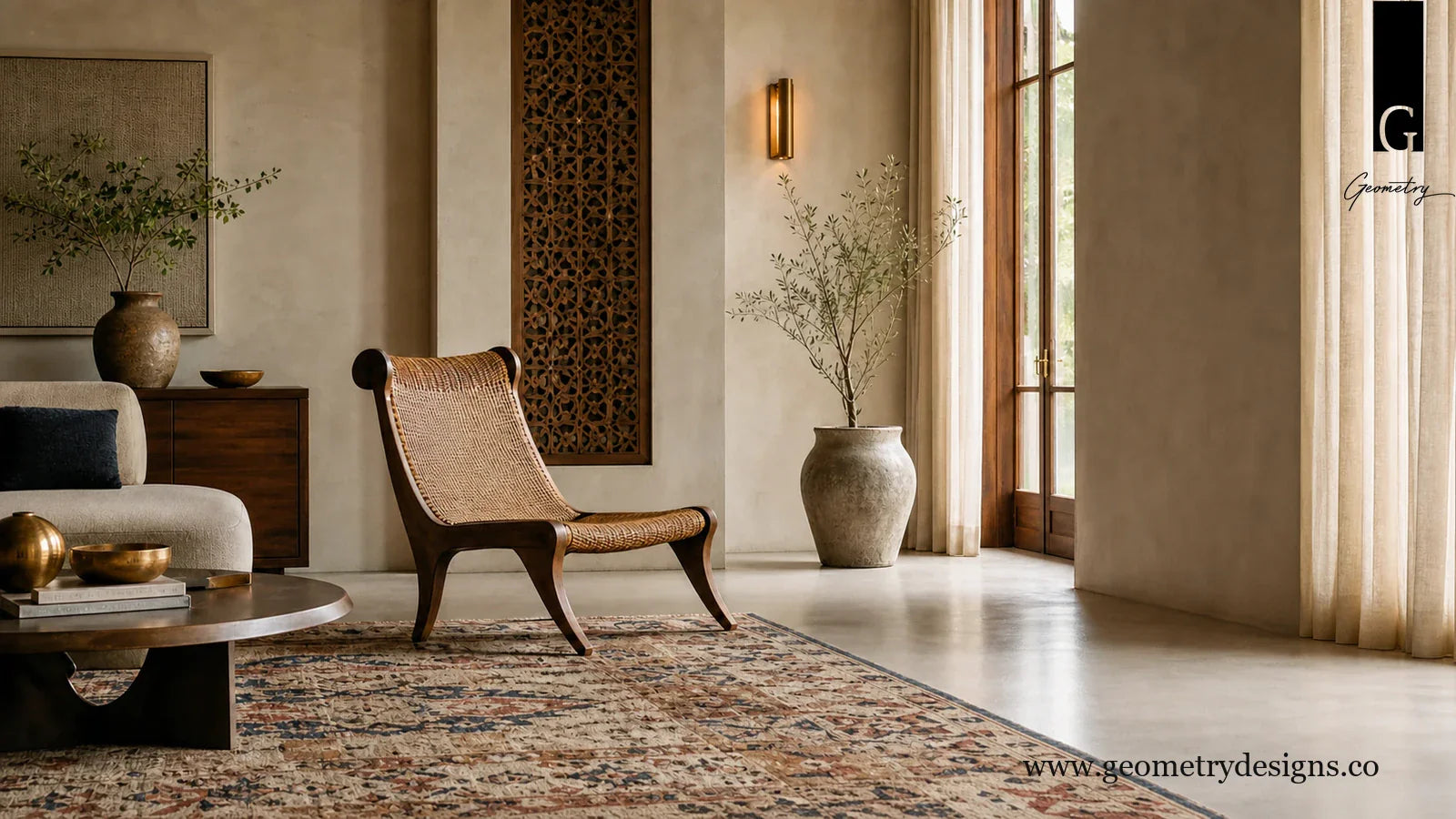
How to Match Statement Seating With Rugs and Accessories
Short answer: Statement seating works best with rugs and accessories when the chair, rug, and decor have one clear hierarchy: the seat leads, the rug frames it, and accessories support the mood without competing. Match scale before colour, repeat one material or tone, and leave enough negative space so the room feels styled rather than crowded.
In a modern Indian luxury home, statement seating should feel like a clear design decision, not a lonely showpiece. A memorable armchair, accent chair, loveseat, or sofa needs the right rug and accessories around it so the room has rhythm, comfort, and a reason for every object.
What should lead: the chair, the rug, or the accessories?
Let the seat lead when its shape, colour, craft detail, or silhouette is the strongest design moment. Let the rug lead only when it has a very bold pattern or large colour story. Accessories should almost never lead; they are the finishing actors, not the hero entry.
A simple rule helps: choose one hero, one frame, and one supporting note. If the chair is sculptural, keep the rug quieter and repeat one tone from the chair in a cushion, lamp, vase, or book stack. If the rug is expressive, choose seating with a cleaner silhouette and use accessories sparingly.
How do you choose the right rug scale?
Start with footprint, not pattern. The rug should be large enough to visually hold the seating zone, especially in a living room where a chair sits near a sofa or coffee table. A too-small rug makes the statement seat feel disconnected; a generous rug makes the same chair feel intentional.
For a reading corner, the chair should sit fully on the rug or at least feel visually anchored by it. For a larger living room, align the rug with the front legs of the seating group and keep a clear walking path around the arrangement.
How should colours and patterns be matched?
Do not match everything. Rooms become more luxurious when they look coordinated, not copied. Pick one shared cue: a warm wood tone, a brass accent, a muted blue, a woven texture, or a soft neutral base. Then let the rest breathe.
If the chair has a strong form, choose a rug with controlled movement rather than loud contrast. If the rug has pattern, keep accessories in solid textures such as ceramic, stone, wood, metal, glass, or linen. This gives the eye somewhere calm to rest.
What accessories make statement seating look finished?
Use accessories that explain how the seat will be lived with. A floor lamp suggests reading. A small side table suggests conversation. A textured cushion adds comfort. A sculptural vase or low bowl can echo the craft language without overcrowding the composition.
Avoid placing too many small pieces around a statement chair. Several tiny accessories can make premium furniture look busy. Fewer, better-scaled objects feel more intentional and more Geometry.
Quick Geometry pairing checklist
- Scale first: the rug must be large enough to hold the seating zone.
- One hero only: let either the seat or the rug be visually dominant.
- Repeat one cue: echo one colour, finish, or texture across the chair, rug, and accessory.
- Control clutter: use two or three meaningful accessories, not a full tabletop display.
- Check movement: keep circulation clear around the seat and rug edge.
- Respect craft: if the piece has woven, carved, inlay, or hand-finished detail, do not cover it with too many props.
What mistakes make the room feel crowded?
The most common mistake is adding contrast everywhere: bold chair, bold rug, bold cushions, bold table, bold wall art. Each element may be beautiful alone, but together they start competing. Another mistake is choosing accessories that are too small for the scale of the seating. Tiny pieces can make a large chair or sofa feel heavier than it is.
A better approach is to create pauses. Leave open floor around the rug. Keep one side table edited. Use a single lamp, vase, or book stack where it adds function. Luxury often arrives through restraint.
Where can Geometry pieces fit into this approach?
For seating-led rooms, browse Geometry Designs' accent chairs, arm chairs, and sofas to understand the shape and scale of the anchor first. If you are still deciding the whole room language, start from the Shop All collection or learn more about the brand's point of view on About Geometry Designs.
FAQ
Should a statement chair match the rug exactly?
No. Exact matching can make a room feel flat. A stronger approach is to repeat one colour, material mood, or texture while allowing the chair and rug to have their own roles.
Can a patterned rug work with a bold chair?
Yes, if one of them is clearly quieter in scale or colour. If both are bold, keep the accessories restrained and make sure the room has enough negative space.
What accessories are safest around statement seating?
A good lamp, a correctly scaled side table, one cushion, one tray or bowl, and one vase are usually enough. Choose pieces that support comfort and proportion instead of adding decoration for the sake of it.
How do I stop a luxury living room from looking cluttered?
Limit the number of visual heroes. Use the rug to frame the seating, keep circulation visible, and remove accessories that do not add comfort, function, or a clear design note.
CTA
Explore Geometry Designs seating and room-led furniture pieces in the Shop All collection, or contact Geometry if you want help building a statement seating corner with the right rug and accessories.


