

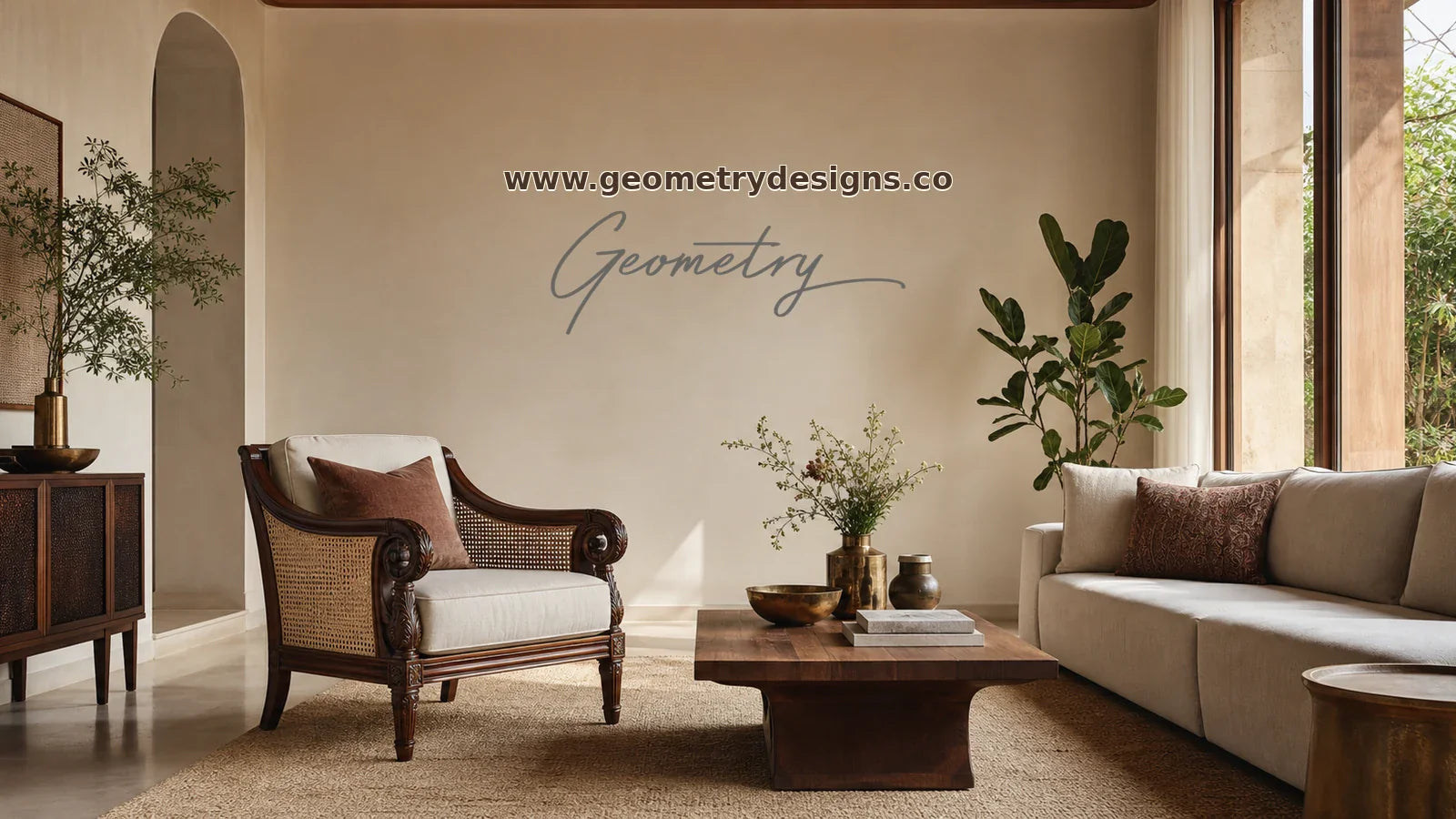
Short answer: Layer Indian craft by choosing one clear hero detail, repeating materials quietly, and leaving enough negative space around every handcrafted piece. The goal is rhythm, not a showroom of every technique at once.
In a modern Indian luxury home, craft should feel lived with, not displayed like a souvenir shelf. Geometry Designs' point of view is simple: let Indian soul show through proportion, texture, restraint, and one memorable handmade detail at a time.
Why do craft-led rooms become busy?
Rooms feel busy when every object asks for attention at the same volume. A carved chair, patterned rug, brass lamp, inlay table, printed cushion, and ornate mirror can all be beautiful individually, but together they may compete instead of converse.
The solution is not to remove craft. It is to edit the hierarchy: one hero, two supporting notes, and plenty of breathing room.
What should be the hero detail?
Pick one detail that deserves the first look. It could be a handcrafted chair profile, a carved console front, a woven cane texture, a rug border, a brass accent, or a sculptural mirror. Once the hero is chosen, other craft notes should become quieter.
If a chair is the hero, keep the table simpler. If the rug is the hero, let the upholstery settle down. If the wall has texture, reduce the number of small decorative objects.
How do you layer without clutter?
- Repeat one material family: warm wood with cane, brass with muted stone, or textile with carved detail.
- Use negative space: leave visible wall, floor, or surface around important craft pieces.
- Control the palette: keep colour calmer when pattern or texture is strong.
- Separate scales: combine one large craft gesture with smaller, quieter details.
- Edit surfaces: a handcrafted console does not need five objects on top to prove its beauty.
How much pattern is enough?
Pattern should have a job. It can warm a room, connect colours, add Indian rootedness, or bring softness to clean architecture. But if the eye cannot rest, reduce either the number of patterns or their contrast.
A practical rule: let one patterned piece speak clearly, then keep the surrounding pieces tonal, textured, or plain.
Where does furniture help?
Furniture gives craft a structure. A strong chair, console, table, or mirror can carry handcrafted detail while still keeping the room useful. Browse Geometry arm chairs or accent chairs when the room needs one expressive piece rather than many small decorative layers.
For larger spaces, look at Geometry projects to see how proportion and breathing room matter as much as the individual objects.
Founder-style note
The most memorable Indian luxury rooms rarely shout. They usually have one piece that makes you look twice, and then everything around it behaves beautifully. That is the sweet spot: rooted, not rustic; detailed, not crowded.
FAQ
Can Indian craft work in a very modern room?
Yes. It often works best when the architecture and palette are clean, because the craft detail gets room to breathe.
How many handcrafted pieces should one room have?
There is no fixed number, but the room should have a clear hierarchy. If every piece is a focal point, none of them feels special.
Should handcrafted furniture match exactly?
No. It should relate through material temperature, scale, or mood. Exact matching can make craft feel flat.
What is the easiest way to reduce visual busyness?
Remove small surface objects first, then reduce high-contrast pattern. Often the main furniture can stay; the noise is in the extras.
CTA: contact Geometry Designs to plan one craft-led focal piece that feels calm, premium, and personal.


